Disclosure
This article contains affiliate links. If you buy through one, we may earn a small commission at no extra cost to you. Read our fulldisclosure policy.
In this article11 sections
Wallpaper is the fastest way to give a plain bedroom character, and the decision that people most often get wrong — usually by papering the wrong wall or choosing a pattern that overwhelms the room.
Here’s the practical version, with the numbers you’ll need.
Which wall to paper
The wall behind the bed. This is the answer nine times out of ten.
It’s the natural focal point, the bed frames it beautifully, and — importantly — it’s the wall you don’t look at while lying in bed. A busy pattern facing you as you try to sleep is a genuine mistake.
Avoid papering:
- The wall opposite the bed, unless the pattern is very quiet
- Walls broken up by doors, windows and radiators — you lose the pattern and waste paper
- All four walls in a small room, unless the pattern is subtle
Worth considering: papering the ceiling. Unexpected, dramatic, and in a bedroom you actually look at it.
How much you need
Measure the wall width and height in metres.
Standard roll: 10.05m long, 0.53m wide — covers roughly 5 square metres, but you’ll get less with pattern matching.
Quick method:
- Wall width ÷ 0.53 = number of drops needed
- Wall height + pattern repeat + 10cm trim = length per drop
- 10.05 ÷ length per drop = drops per roll
- Drops needed ÷ drops per roll = rolls to buy
Always round up and buy one extra roll. Batch numbers vary between print runs, and matching later is often impossible. The spare also covers future repairs.
Pattern repeat matters enormously. A large repeat can waste 30% of each roll. Check the repeat before calculating.
Peel-and-stick vs traditional
Peel-and-stick
Good for: renters, first-timers, small areas, anyone who wants to change it in two years.
Reality: needs a very smooth, clean, non-textured wall. It lifts at seams over time, especially in humid rooms. Removes cleanly from most sound paint — but not always from freshly painted or low-quality surfaces.
Traditional paste-the-wall
Good for: a lasting result, better print quality, and a much wider choice of designs.
Reality: more work, but paste-the-wall (rather than paste-the-paper) is far more beginner-friendly than it used to be. Removal is harder.
For a feature wall you plan to keep, traditional is usually the better choice. For a rental or a child’s room, peel-and-stick.
Affiliate link: we may earn a commission if you buy, at no extra cost to you.
Wallpaper pick Akodm Sage Green Floral Peel and Stick WallpaperPatterns that suit small bedrooms
Vertical patterns — stripes, tall florals, vertical botanicals. Draw the eye up and make ceilings feel higher.
Small-scale repeats — ditsy florals, small geometrics. Read almost as texture from a distance.
Textured or plain-effect papers — grasscloth, linen-look, plaster-effect. Add depth with no visual busyness. Excellent in small rooms.
Tonal patterns — pattern in two shades of the same colour. Interest without noise.
Murals — a single large-scale scene, landscape or forest. Counterintuitively, these work well in small rooms because they create depth rather than repeating pattern.
What to avoid in a small room: large bold repeats in high contrast, and dark heavy patterns on all four walls.
Styles that work in bedrooms
Botanical and floral — the most popular bedroom choice. Soft, calming, works with almost any furniture.
Grasscloth — natural woven texture, warm, no pattern to tire of. One of the most expensive-looking options.
Plaster or limewash effect — subtle movement and depth, reads as a finish rather than wallpaper. Very current.
Toile and traditional prints — best in a period home, and beautiful behind a simple bed.
Geometric — modern and graphic. Keep it low-contrast in a bedroom or it feels restless.
Mural — forest, mountains, a faded landscape. Dramatic and calming at the same time.
Stripes — timeless. Vertical for height, and they suit both traditional and modern rooms.
Coordinating the rest of the room
Once one wall is patterned, everything else should quieten down.
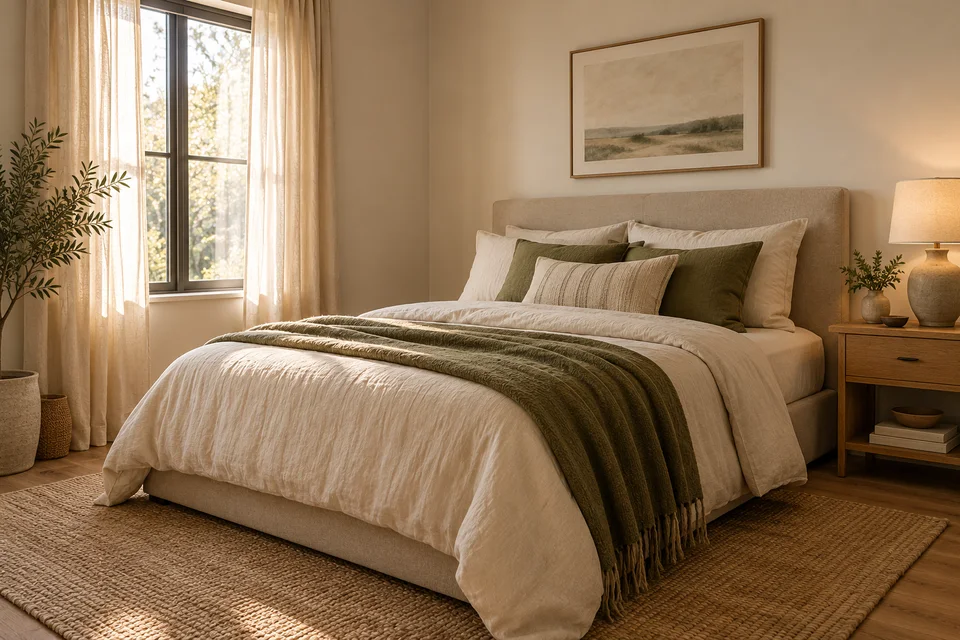
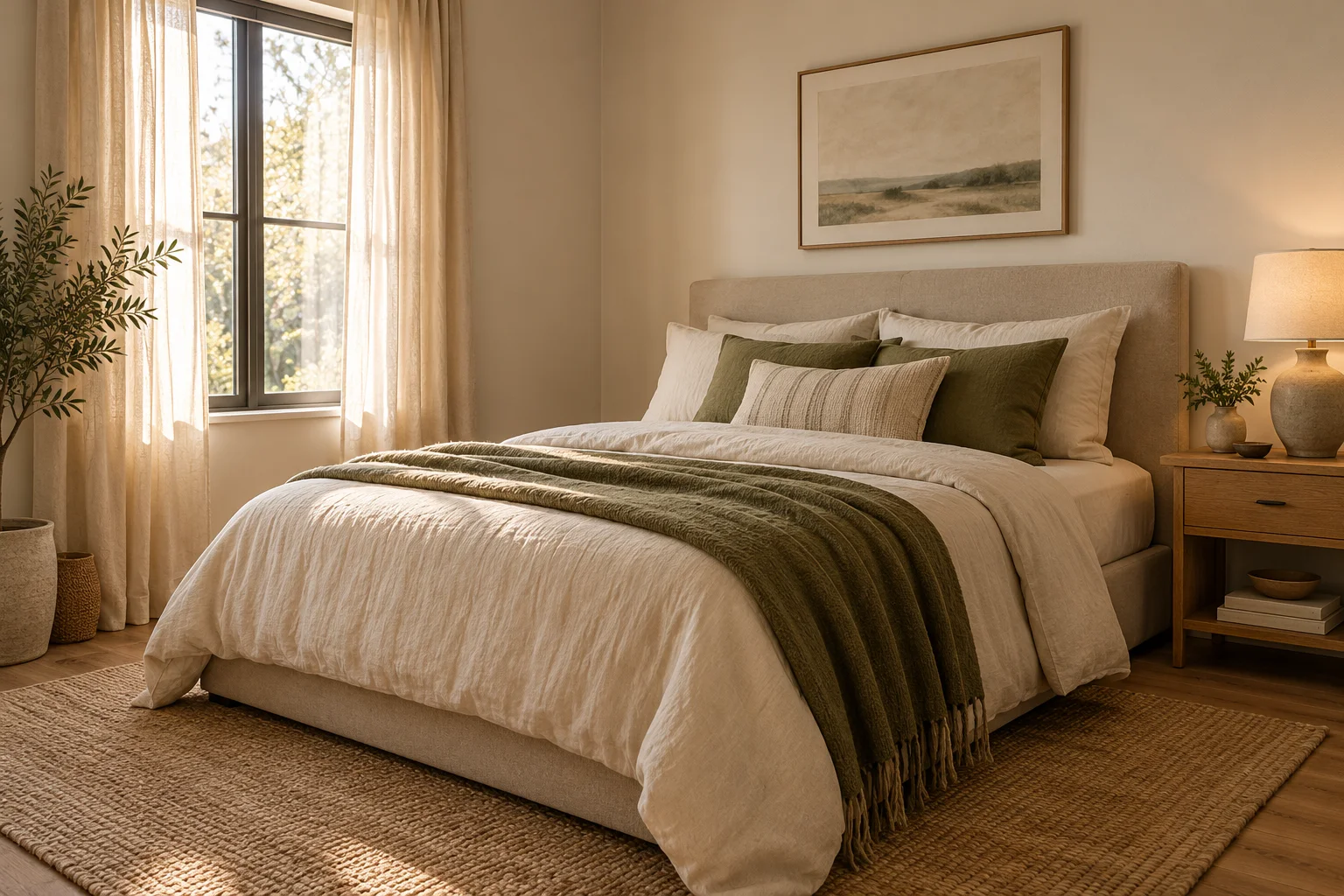
- Paint the other three walls in a colour pulled from the wallpaper — usually its background tone
- Bedding solid, in one of the paper’s colours
- Curtains plain, not a second pattern
- One texture repeated — wood, rattan, linen
- Art: keep the papered wall clear, or hang one piece only
A patterned wall plus patterned bedding plus patterned curtains is where bedrooms go wrong.
Practical considerations
Radiators and sockets — papering around them is fiddly. Factor extra time.
Sloped ceilings — pattern matching on a slope is genuinely difficult. Use a plain or textured paper.
Damp — never paper over a damp wall. Fix the cause first.
Wall condition — fill and sand first. Wallpaper highlights bumps rather than hiding them, especially peel-and-stick.
Lighting — check a sample on the wall at different times of day. Patterns look completely different in morning light versus lamplight.
Order samples, always
Order two or three samples and tape them to the wall for a week. Look at them in daylight, in the evening, and with the curtains closed.
A pattern that looks perfect on a screen frequently looks busy or dull on an actual wall, and a sample costs almost nothing compared to a room’s worth of paper.
Budget approach
- Paper one wall, not four
- Choose a small repeat to reduce waste
- Peel-and-stick for a first attempt
- Watch the pattern repeat number — a small repeat can halve your roll count
- Behind-the-bed wall only, since the headboard hides the trickiest bottom section
Quick decisions:
| Question | Answer |
|---|---|
| Which wall? | Behind the bed |
| How many rolls? | Calculate, then add one |
| Small room? | Vertical, small repeat, or textured |
| Renting? | Peel-and-stick, on smooth walls only |
| Other walls? | Plain, in the paper’s background tone |
| Before ordering? | Sample on the wall for a week |
Paint the Wall Behind the Bed a Deep Color
A deep color — navy, charcoal, forest green, terracotta, or dusty plum — on the wall behind the bed is the simplest and most effective accent wall approach. It costs one tin of paint and a few hours.
Keep the other three walls white or a warm off-white so the accent wall reads clearly.
Hang One Large Piece of Art
A single large canvas or framed print centered above the bed is the simplest and most effective approach. The art should be roughly two-thirds the width of the bed — about 40 inches for a double, 50 inches for a king.
Hang it 6–10 inches above the headboard with the center at 57 inches from the floor.
Save it
Pin this for your board
Use the Save button to keep this idea on Pinterest and come back when you are ready to start.