In this article13 sections
A lot of boys’ bedrooms photograph beautifully and fall apart in six months. Pale rug, matte walls, delicate bedding, open shelves of small objects — none of it survives an actual child.
This is the durability version. Same look, chosen so it still looks good a year later.
Materials that survive
Walls: eggshell or satin, never matte. Matte paint cannot be wiped. One handprint at 40 inches and you’re touching up. Satin takes a damp cloth and keeps going for years.
Flooring: luxury vinyl plank or a low-pile wool rug. Skip shag and skip pale cream. A mid-tone pattern hides more than any amount of cleaning.
Bedding: cotton percale or waffle weave. Washes at 60°C, doesn’t need ironing, gets better with age. Linen looks great and creases into chaos.
Furniture: solid wood or laminate with a rounded edge. MDF with a thin veneer chips at every corner within a year.
Curtains: machine washable, blackout lined. Every fabric in a child’s room should be washable. No exceptions.
Choose finishes that hide life
- Mid-tone walls — navy, sage, greige. Pale walls show every mark; very dark walls show every dust.
- Patterned rug rather than solid
- Dark grout if there’s any tile
- Matte black or brass hardware — fingerprints vanish on both. Chrome and polished nickel show everything.
- Textured bedding — a waffle or knit hides creases that flat cotton advertises
Layouts that stay tidy
The room stays tidy or doesn’t based on how easy tidying is. Design for the laziest possible version of putting things away.
Bed in the corner — frees the middle of the room and means only two sides to make.
One large open basket near the door for the things that get dropped on entry.
Under-bed drawers on castors — the easiest storage in a room to actually use, because it takes one pull.
Hooks instead of hangers. A hook on the back of the door catches the dressing gown, the school bag and the hoodie. A wardrobe rail catches none of them.
Everything daily below 40 inches. If he can’t reach it easily, it won’t get put away.
The three-minute tidy test
A well-designed boys’ room can be reset in three minutes. If yours can’t, there’s a storage gap somewhere.
Walk the room and ask where each thing that’s on the floor is supposed to go. If the answer is “in the wardrobe, in a box, at the back,” that’s the gap. Bring it forward into an open bin.
Durable decor
- Framed art behind glass or acrylic — wipeable, survives a stray football
- Picture ledges instead of nails, so art swaps with no new holes
- Pegboard — infinitely reconfigurable as his interests change
- Wall decals rather than murals — removable, no repainting
- A pinboard so things stop getting taped to paint
Lighting that takes a knock
Floor lamps get knocked over. Wall-mounted sconces and clip-on lights don’t.
If you want a bedside lamp, choose one with a weighted base and a touch switch — no fiddly little rotary switch that breaks.
Warm bulbs, 2700K, on a dimmer if possible.
Cool without committing
The “cool” part of a boys’ room should live entirely in the changeable layer:
- Bedding
- Cushions and throw
- Art and posters (framed)
- Rug
- Lampshade
- Decals
- Whatever’s on the shelf
The permanent layer — paint, furniture, curtains, flooring — stays neutral and grown-up. That way “cool” can change from dinosaurs to football to gaming without a single tin of paint.
Making the bed easy
Boys will not make a bed with a top sheet, a blanket, a bedspread and five cushions.
Duvet only, no top sheet. One pull and it’s made.
A duvet cover with a zip rather than buttons.
Two pillows maximum, one accent cushion.
The bed is the biggest visual element in the room. If making it is easy, it gets made, and the whole room looks better as a result.
Room for the mess that’s part of it
A boy’s room needs one place where mess is allowed. A Lego table, a corner of floor, a large tray.
Contained mess is fine. Mess with nowhere to be spreads to the whole room. Give it a footprint and the rest of the space stays calm.
Durability checklist:
| Element | Choose |
|---|---|
| Wall paint | Eggshell or satin, mid-tone |
| Flooring | LVP or low-pile patterned rug |
| Bedding | Cotton percale or waffle, duvet only |
| Hardware | Matte black or brass |
| Storage | Open bins below 40 inches |
| Lighting | Wall-mounted, warm, dimmable |
| Art | Framed behind glass, or picture ledge |
The rule that saves money: theme the cheap layer
Split the room into two layers.
Permanent layer — paint, flooring, bed frame, storage furniture, curtains. Keep these neutral and grown-up. These cost real money and shouldn’t change.
Temporary layer — bedding, wall decals, cushions, art, rug, toy bins, lampshade. This is where the dinosaurs, rockets and diggers live. All of it costs under a few hundred and can change in an afternoon.
Do it this way and the room evolves from dinosaurs to football to gaming without a single tin of paint.
Layer 1: The bed, done properly
The bed is 40% of the visual weight in the room, so it does most of the work.
Build it in three parts:
- Fitted sheet — plain, in a colour that coordinates rather than matches
- Duvet or comforter — the main colour statement
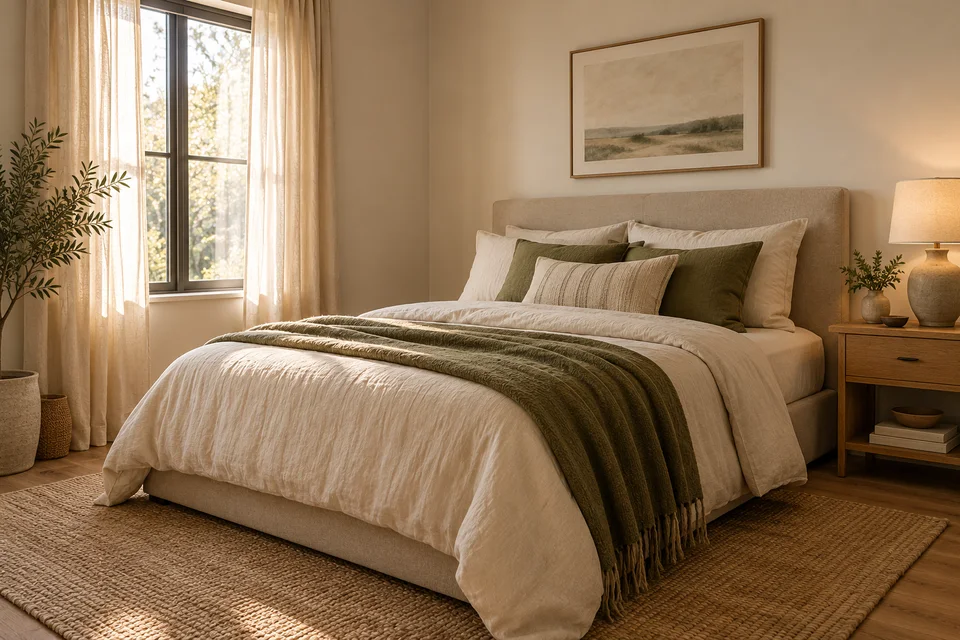
- One throw folded across the bottom third — this is the layer that makes a bed look styled rather than made
Add two pillows for sleeping plus one accent cushion. Not five. Boys will not arrange five cushions, and unarranged cushions look worse than none.
Texture over pattern. A waffle-weave, chunky knit or linen duvet in a solid colour looks more expensive than a busy printed one, and it doesn’t date.
The charging station
Phones, tablets, controllers, headphones. Without a designated spot, cables snake across the desk and the bedside table permanently.
The setup: a small drawer or a shallow box on the bedside table, one multi-port charger inside, cables fed through a hole drilled in the back.
Devices go in, charge overnight, no visible cables. If you want them out of the bedroom entirely at night, put the station on the landing instead — a decision worth making deliberately rather than by default.
Use Clean-Lined Furniture
Simple, straight-edged furniture in wood, white, or black gives a boys bedroom a modern feel that will not look dated as the child grows. Avoid overly ornate or themed pieces.
Measure the furniture footprint and the path around it before buying.
Save it
Pin this for your board
Use the Save button to keep this idea on Pinterest and come back when you are ready to start.