In this article8 sections
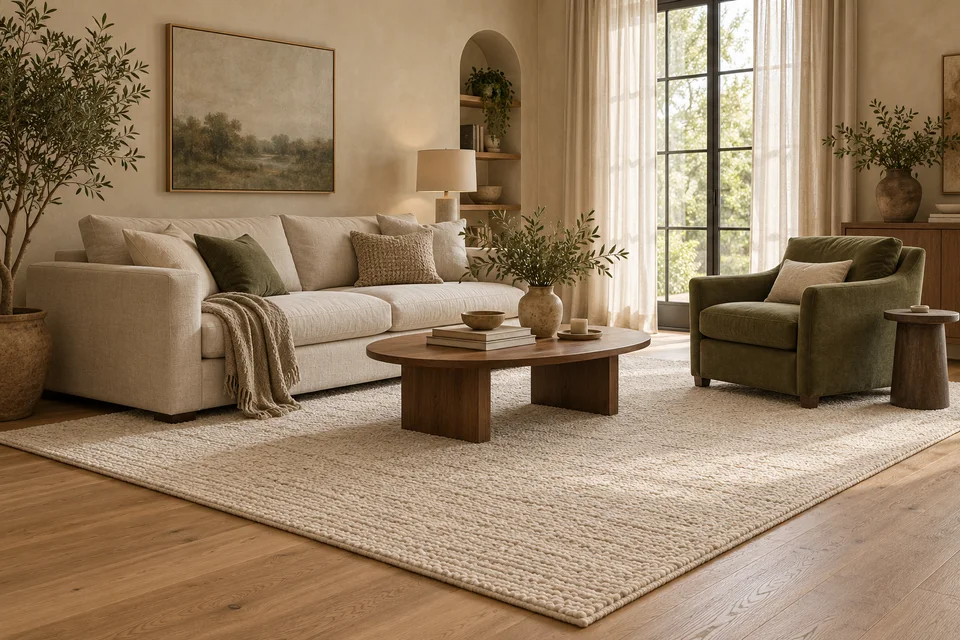
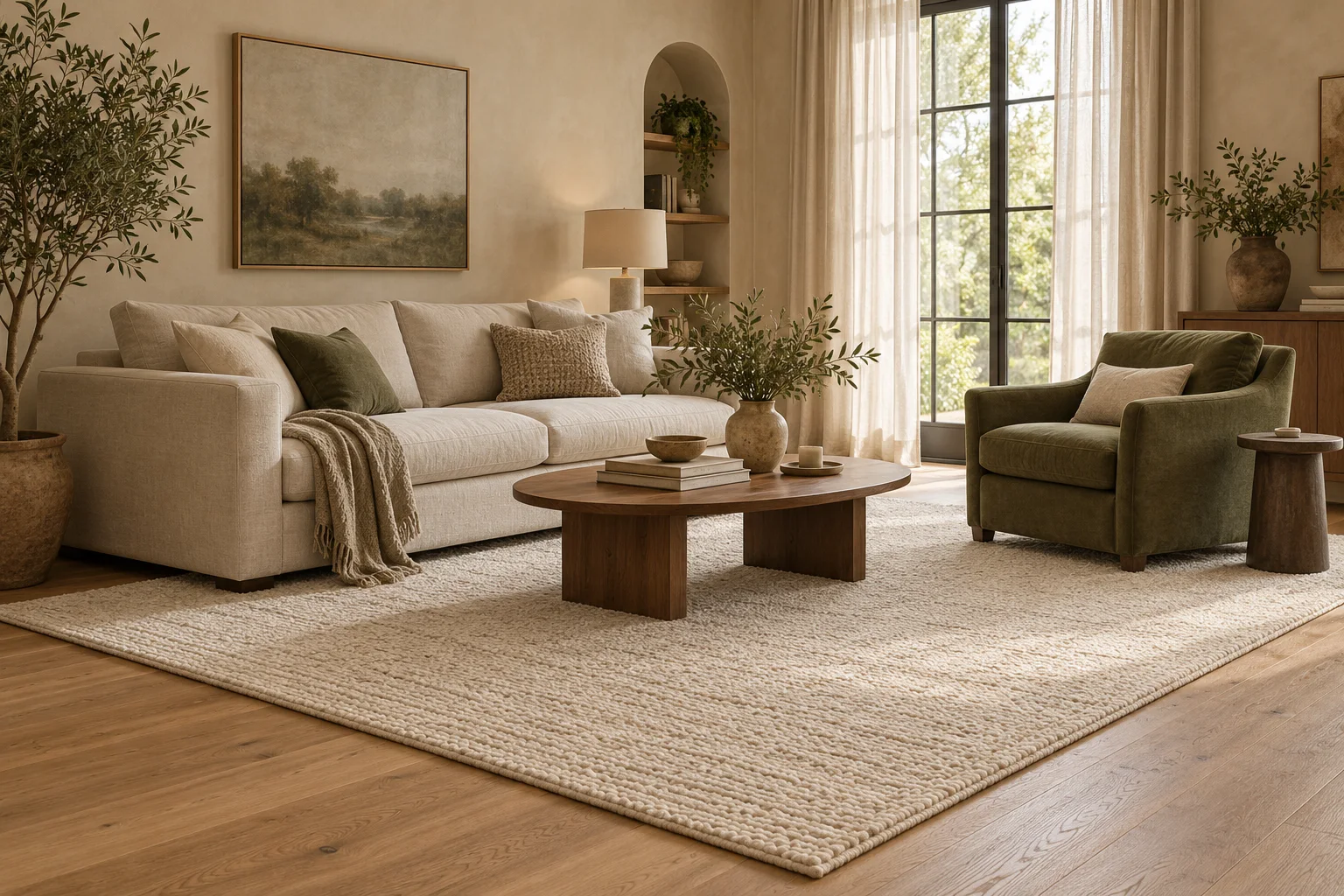
A rug can look generous in a shop and become a small island beneath your coffee table at home. The useful measurement is the footprint of your seating group: sofa, chairs and the space people actually use between them. This guide gives you a way to compare layouts before committing to a purchase. The AI-generated interior illustrates a possible arrangement, not a tested installation.
Start with the furniture in its everyday position
Put the sofa and chairs where you normally use them. Pull out a recliner, open the nearby cupboard and move any nesting tables into their usual positions. A rug selected for a temporarily tidy photograph may interfere with how the room works.
Write down the width of the sofa, the outside-to-outside width of the seating group, and the distance from the sofa front to the farthest chair legs. Sketch the doorway and main walking route on the same sheet. You do not need a scaled drawing; labeled measurements are enough to compare available sizes.
Compare these three arrangements
| Arrangement | What to check | Main trade-off |
|---|---|---|
| Front legs of seats on the rug | Each seat reaches the rug by a similar amount | Useful for linking a group without covering most of the floor |
| All furniture legs on the rug | The rug extends beyond the group on every side | Requires more floor area and may be harder to move for cleaning |
| Rug inside a compact seating group | The exposed border looks deliberate and the rug stays stable | Can make separate pieces feel less connected |
These are visual options rather than rules. An asymmetrical room may need an offset arrangement to keep the route to a balcony or kitchen clear.
Mark two candidate footprints
Use loose paper strips or a sheet folded to size to outline each candidate. If you use tape, first confirm that it is suitable for the floor finish and test it discreetly. Remove the markers after the comparison so they do not become a trip hazard.
For example, compare a 160 × 230 cm rectangle with a 200 × 300 cm rectangle. These are sample footprints, not a recommendation for every sofa. Photograph each from the doorway, then sit down and look at the visible border around the coffee table. Check whether chair legs sit awkwardly across an edge.
Test the details that a floor outline cannot show
An outline does not reproduce thickness. Check the rug and underlay specifications against the clearance beneath inward-opening doors. Consider whether a raised edge crosses your normal walking route. Choose an underlay compatible with both the rug and your flooring; follow the manufacturers’ care and installation instructions.
If furniture is heavy, plan how you will place the rug before delivery. Do not assume a large rug will be easy to pull beneath a fully loaded sofa.
Compare the sizes with a worked example
Imagine a sofa 210 cm wide, centered on the long side of each sample rug. A 160 × 230 cm rug leaves 10 cm beyond each sofa end: (230 − 210) ÷ 2. A 200 × 300 cm rug leaves 45 cm at each end. Those figures describe the width only; neither tells you whether the rug reaches the chairs or clears the doorway.
Now mark the rug’s depth from the sofa toward the chairs. If the smaller footprint leaves a chair’s front legs on the edge, either adjust the chair without narrowing the walkway or compare the larger footprint. If the larger one crosses a frequently used doorway, test a different orientation or furniture arrangement. Choose the option that works from the doorway and from the seat, not only from above.
Match the material to the way you use the room
| Everyday constraint | Check before buying |
|---|---|
| A desk chair shares the space | Whether the chair rolls across the rug and edge without catching |
| Frequent spills or muddy shoes | The actual cleaning instructions, rather than a general “easy care” label |
| A low door swings over the rug | Combined rug and underlay thickness, including any raised edge |
| A robot vacuum cleans the room | The vacuum’s stated obstacle clearance and restrictions around fringe |
| Furniture needs frequent rearrangement | Rug weight, underlay movement and whether lifting help is needed |
“Washable” also needs a practical check: confirm the washing method, machine capacity requirements and drying instructions for the exact size. A care label for a small version may not describe a larger rug in the same collection.
When neither size works
Do not buy the larger option just to make every chair touch the rug. Try moving one occasional chair out of the group, rotating the rug, or leaving a secondary seat outside the rug area. Keep the main walking route usable. If the rug must sit independently, choose a position where its edges look intentional and do not land under an unstable furniture leg.
Record the final choice
Record your preferred footprint, acceptable alternatives, door-clearance constraint and care needs. Also note the return conditions before ordering. If both sizes work, choose based on how much floor you want visible and the practicalities of cleaning, rather than assuming bigger is always better.
If the furniture arrangement still feels awkward without a rug, resolve that first with our living-room layout guide.
Make it work in your home
Your rug comparison notes
Keep your measurements in one unit. These notes stay on this page and are not saved or sent anywhere; print them before leaving.
Save it
Pin this for your board
Use the Save button to keep this idea on Pinterest and come back when you are ready to start.