In this article8 sections
When drilling is not an option, it is tempting to replace wall hooks with adhesive ones. But sometimes the better answer is a different layout. A small landing place can work without hanging anything on the wall, provided it fits the door swing and holds only what you need when coming and going.
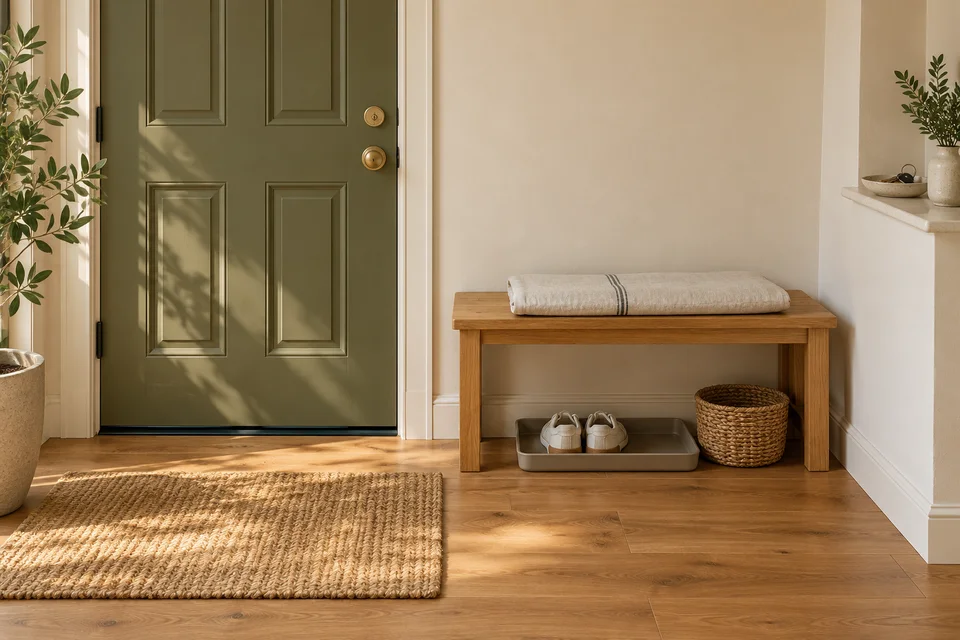
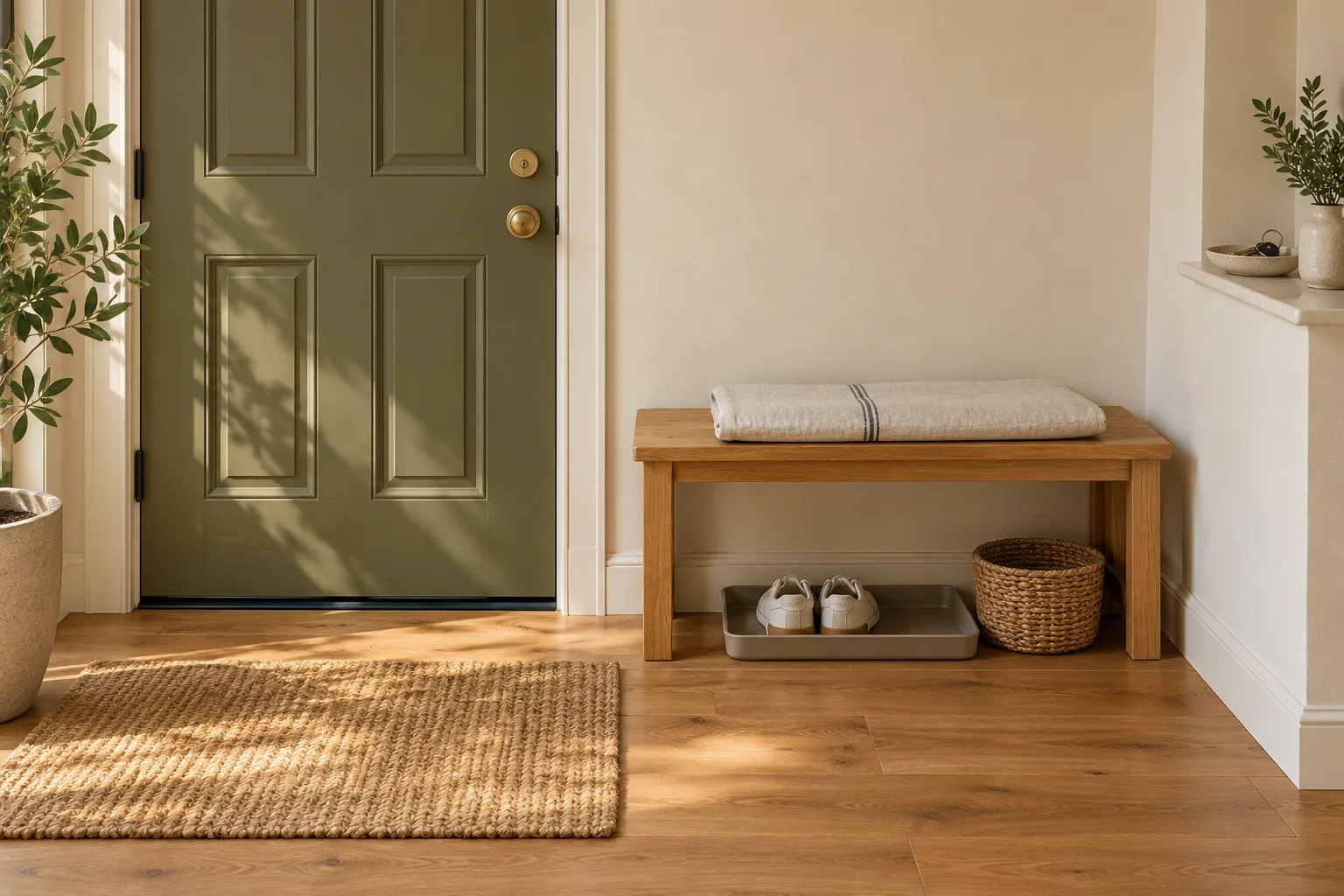
The three layouts below are planning suggestions. Choose one after measuring your own entrance; the AI-generated illustration is inspiration rather than a record of an installation.
First, map the space the door needs
Open the front door fully and check nearby cupboard doors too. Mark the area that must remain empty, then walk through carrying a normal bag. Keep the exit route clear. If the remaining floor area is too narrow for furniture, place the landing spot farther inside the home instead of forcing it beside the door.
List the items that arrive with you every day. Separate those from spare shoes, occasional coats and paperwork that belongs elsewhere. The entryway should handle a daily handoff, not become the storage room for everything you own.
Layout one: a shoe tray and an existing surface
Use a shallow tray for the pair of shoes you are wearing regularly. Put a small key dish on an existing shelf or table nearby. This works when the doorway itself has no room for a console.
Check that the tray does not slide and that its edge is outside the walking route. Leave wet shoes to dry as appropriate for their material, and clean the tray instead of allowing dirt to build up beneath it. If more shoes arrive than the tray holds, rotate them to a separate cupboard rather than adding another tray in the walkway.
Layout two: a slim console with one container
A shallow console can hold a key dish and a container for mail. Before choosing one, measure its full depth including handles or projecting legs. Place a box of the same footprint in the proposed spot temporarily and test the door again.
Keep heavy bags off a narrow tabletop that could tip. Follow all furniture anchoring instructions. If the manufacturer requires wall fixing and your rental does not permit it, choose another solution; adding weight at the bottom is not a substitute for required anchoring.
Layout three: a compact seat with a clear top
If you sit to put on shoes, prioritize a stable seat over a decorative console. Use a seat intended for sitting, within its stated load rating. A storage box is not automatically a bench.
Keep the seat clear and limit storage underneath to a basket that pulls out without blocking the entrance. This arrangement gives up display space in exchange for a useful daily function. A separate dish on a nearby surface can still handle keys.
Choose the layout by the constraint
| Your entrance | Start with | Avoid |
|---|---|---|
| Door opens into nearly all available floor space | A key dish farther inside and shoes in an existing cupboard | Adding a narrow item simply because it technically fits |
| There is a usable wall beside the door | A console footprint marked with a temporary box | Assuming the tabletop depth includes projecting feet |
| Sitting to change shoes is the main need | A purpose-made stable seat | Using a decorative storage chest without a seating rating |
| Two people arrive together | Separate item destinations beyond the threshold | A single basket that everyone must stand in the doorway to reach |
A simple footprint example
Suppose a console’s top is 25 cm deep but its feet project another 5 cm. Mark 30 cm from the wall when testing it. Open the door, carry your usual shopping bag through, and try accessing the nearby cupboard. The remaining passage must satisfy the needs of your household and any applicable building requirements; this example does not establish a safe minimum width.
Next, test the console with a drawer or basket extended. A layout can pass the closed-furniture test and still block the entrance when somebody reaches for a scarf. Measure both states before ordering.
Try the routine before buying furniture
For a few ordinary arrivals, use an existing dish for keys and an existing cupboard for spare shoes. Note which objects still end up on the floor. If the problem is unopened mail, another shoe rack will not help. If bags occupy the seat, give them a separate destination that does not require moving them whenever somebody sits down.
Use temporary boxes only while checking a footprint, then remove them from the entrance. Once you choose furniture, check its assembly and anchoring instructions before purchase. “Freestanding” in a product name does not mean wall anchoring is optional.
Keep the daily handoff simple
Give each item a simple destination: shoes in the tray, keys in the dish, mail in one container. Empty the mail container regularly. If bags keep landing on the seat, move their storage to a room with enough space instead of buying another piece for the entrance.
Finish with one color or material repeated from the adjoining room. A small entrance can feel intentional without a mirror, artwork and a lamp competing for the same surface. For more spatial ideas, see our small-entryway guide.
Make it work in your home
Your entryway plan
Keep your measurements in one unit. These notes stay on this page and are not saved or sent anywhere; print them before leaving.
Save it
Pin this for your board
Use the Save button to keep this idea on Pinterest and come back when you are ready to start.